September 22, 2026
Manaslu Circuit Trek Packing List
 By admin
Manaslu Circuit Trek Packing List: What to Pack for Larkya La and High-Altitude Trekking
The Manaslu Circuit Trek takes you from the lower hills of Nepal into the high Himalayas, crossing diverse landscapes and reaching the challenging Larkya La Pass at 5,106 meters. Because the trek involves changing temperatures, long walking days, rocky trails, and high-altitude conditions, packing the right equipment is essential.
A good Manaslu Circuit Trek packing list should prepare you for warm days at lower elevations, cold nights at higher elevations, strong winds around Larkya La, and possible rain or snow depending on the season. At the same time, you should avoid carrying unnecessary items because a heavy backpack can make the trek more tiring.
Most trekkers use a porter for their main luggage and carry a smaller daypack themselves. This makes it easier to keep essential items with you while your main belongings are transported between overnight stops.
This guide explains what to pack for the Manaslu Circuit Trek, including clothing, footwear, sleeping equipment, bags, trekking accessories, personal items, electronics, health supplies, and other useful essentials.
Clothing for the Manaslu Circuit Trek
Layering is the most practical way to dress for the Manaslu Circuit Trek. Temperatures can change significantly as you move from lower valleys to higher elevations, so wearing several lightweight layers allows you to adjust your clothing throughout the day.
You may start the morning in cold conditions, become warmer while climbing, and then need additional layers again when the temperature drops in the afternoon or evening.
Base Layers
Pack one or two moisture-wicking thermal tops and bottoms. Base layers help retain body heat while keeping you comfortable during cold mornings, evenings, and nights at higher elevations.
Avoid relying on cotton as your main base layer because it absorbs moisture and dries slowly. Synthetic or merino wool fabrics are better suited to trekking because they manage moisture while providing warmth.
Thermal layers are especially useful around higher villages and during the early morning start for Larkya La Pass.
Trekking Shirts
Bring two or three lightweight trekking shirts. Long-sleeve shirts are particularly useful because they protect your skin from strong sunlight, wind, and cooler temperatures.
Choose breathable and quick-drying fabrics. Washing and drying clothes can become more difficult as you gain altitude, so quick-drying materials are practical for a multi-day trek.
You do not need to bring a large number of shirts. A small rotation of lightweight trekking tops is usually enough.
Fleece Jacket
A fleece jacket is an important mid-layer for the Manaslu Circuit Trek. It provides additional warmth during cold mornings, evenings, and cooler trekking days.
Fleece is lightweight, breathable, and easy to pack, making it a practical choice without adding unnecessary weight to your backpack.
Down or Insulated Jacket
A warm down or synthetic insulated jacket is one of the most important items on your packing list.
Temperatures can become very cold at higher elevations, particularly at night and during the early morning when preparing for the Larkya La crossing.
Choose a jacket that is warm but easy to compress into your bag. A good insulated jacket can be worn over your fleece when temperatures drop.
Waterproof and Windproof Jacket
A waterproof outer shell protects you from rain, snow, and strong mountain winds.
Weather conditions can change quickly in the Himalayas, so a waterproof jacket should remain accessible in your daypack rather than being packed deep inside your luggage.
A lightweight jacket that fits comfortably over your fleece and insulated jacket is ideal.
Trekking Pants
Bring two pairs of comfortable trekking pants. Lightweight, quick-drying trousers are suitable for most of the Manaslu Circuit and provide comfort during long walking days.
Convertible trekking pants can be useful during warmer sections at lower elevations, although shorts are generally less important as you move higher into the mountains.
Choose trousers that allow unrestricted movement and are comfortable for steep ascents and descents.
Warm Trousers
One pair of warm or insulated trousers is useful for higher elevations and cold evenings.
You can combine warm trousers with thermal leggings when temperatures become particularly cold instead of carrying several heavy pairs of pants.
Underwear
Bring enough comfortable underwear for the trek, along with a few spare pairs.
Lightweight, quick-drying underwear is practical because laundry and drying conditions become more limited at higher elevations.
Socks
Pack four to five pairs of good-quality trekking socks.
Merino wool or synthetic hiking socks are generally more suitable than cotton because they manage moisture better and provide warmth.
Keep at least one dry pair specifically for sleeping. Dry socks are particularly valuable after a long day of trekking.
Footwear for the Manaslu Circuit Trek
Good footwear is essential because the trail includes rocky paths, steep climbs, uneven terrain, and potentially wet or snowy sections.
Hiking Boots
Bring comfortable, well-broken-in hiking boots with good grip.
Your boots should provide enough support for long days on uneven mountain trails. Waterproof or water-resistant boots are useful because you may encounter rain, wet trails, snow, or muddy sections depending on the season.
Never start a long Himalayan trek with brand-new boots. Wear them before your trip so you know they fit properly and do not cause blisters.
Camp Shoes
A lightweight pair of sandals or comfortable shoes is useful inside teahouses after a long day of walking.
Keep your second pair of footwear light. Heavy shoes add unnecessary weight to your luggage.
Gaiters
Gaiters are optional but can be useful when there is snow, mud, or wet ground.
They help prevent snow, water, and dirt from entering your boots and can be particularly useful during the Larkya La crossing when snow conditions are present.
Microspikes
Microspikes may be useful if the trail is icy or covered with hard-packed snow.
Whether you need them depends on the season and current trail conditions. It is better to check conditions before the trek rather than automatically carrying heavy technical equipment.
Backpack and Luggage
If you are trekking with a porter, a 25–35 liter daypack is generally sufficient for the items you need during the day.
Your daypack should contain:
- Water
- Snacks
- Waterproof jacket
- Warm layer
- Sunscreen
- Sunglasses
- Camera or phone
- Personal medication
- Documents
- Small first-aid items
Keep the things you may need during the day somewhere that is easy to reach.
Duffel or Kit Bag
Your main clothing and equipment can be carried in a trekking duffel or kit bag if you are using a porter.
A soft duffel is more practical than a hard suitcase for the Manaslu Circuit because the luggage is transported along a mountain route.
Use waterproof bags inside your duffel to protect clothing and other equipment.
Dry Bags
Dry bags are useful for organizing and protecting your belongings.
You can use separate bags for clothing, electronics, documents, and sleeping equipment. This also makes it easier to find what you need without unpacking your entire bag.
Trekking Poles
Trekking poles are highly recommended for the Manaslu Circuit.
They can provide balance on rocky trails and reduce pressure on your knees during long descents.
Poles are especially useful when crossing steep sections and descending from Larkya La Pass.
Adjustable trekking poles are convenient because they can be shortened when you do not need them.
Water and Hydration
Staying properly hydrated is important throughout the trek, especially as you gain altitude.
Bring one or two reusable water bottles or a hydration system with enough capacity for your daily needs.
Water is available at teahouses and villages along the route, but you should have a suitable method for treating drinking water.
Depending on your preference, you can carry purification tablets, a water filter, or another appropriate treatment system.
Insulated Bottle
An insulated bottle can be useful at higher elevations.
It can help keep water from becoming extremely cold during early mornings and can provide more comfortable drinking conditions in freezing weather.
Electrolytes
Electrolyte tablets or powder can be useful during long walking days.
They can help replace fluids and electrolytes, particularly after prolonged physical activity.
Sun Protection
Sun exposure becomes stronger at higher elevations, even when the air feels cold.
Sunglasses
Bring good-quality sunglasses with strong UV protection.
They are particularly important around snowy areas because snow can reflect intense sunlight.
Sunscreen
Use a high-SPF sunscreen and apply it regularly to exposed skin.
Pay particular attention to your face, ears, neck, and hands.
Lip Balm
Cold, dry air and strong sunlight can cause cracked lips. A moisturizing lip balm with sun protection is useful throughout the trek.
Sun Hat
A lightweight sun hat or cap provides protection during sunny days at lower and middle elevations.
Head and Hand Protection
A warm fleece or wool hat is essential for protecting your head and ears from cold temperatures, particularly during early mornings, evenings, and at higher elevations.
Gloves
Bring at least two pairs of gloves.
A lightweight liner glove can be used while walking, while a warmer insulated or waterproof pair is useful for cold mornings and the Larkya La crossing.
Having a spare pair is useful if one becomes wet.
Buff or Neck Gaiter
A buff can protect your neck and face from cold wind, dust, and strong sunlight.
It is lightweight and takes up very little room in your backpack.
Personal Hygiene
Bring a compact hygiene kit rather than full-size toiletries.
Useful items include:
- Toothbrush and toothpaste
- Biodegradable soap
- Small towel
- Wet wipes
- Hand sanitizer
- Toilet paper
- Moisturizer
- Lip balm
- Nail clippers
- Personal toiletries
A small quick-drying towel is more practical than a large bath towel.
Wet wipes are useful when shower facilities are limited or when you simply want to freshen up after a long walking day.
First-Aid and Personal Medication
Carry basic medical supplies and any medication you regularly use.
Useful items include:
- Personal prescription medication
- Blister treatment
- Bandages
- Antiseptic wipes
- Basic pain relief medication
- Elastic support bandage
- Basic wound-care supplies
Keep essential medication in your daypack rather than in your main luggage.
Altitude sickness can occur during the Manaslu Circuit because the route reaches more than 5,000 meters. Learn about the symptoms of altitude sickness before your trek and discuss altitude-related medication with a qualified medical professional when appropriate.
Your guide should also be informed about important medications or medical considerations that could affect your trek.
Electronics
You do not need to bring many electronic devices, but a few can be useful.
Mobile Phone
A smartphone can be useful for communication, photography, navigation, and emergencies.
Protect it from moisture and extreme cold, especially at higher elevations.
Power Bank
Bring a reliable power bank because charging facilities can be limited or may involve an additional fee in mountain lodges.
A 10,000–20,000 mAh power bank can be useful depending on how frequently you use your phone and other devices.
Headlamp
A headlamp is an essential item.
It is useful for early-morning departures, moving around the teahouse after dark, and using shared facilities at night.
Bring spare batteries if your headlamp is battery-powered or make sure a rechargeable model is fully charged.
Camera
The Manaslu region offers spectacular mountain scenery, so a camera can be worthwhile if photography is important to you.
However, remember that camera bodies, lenses, batteries, and accessories can add considerable weight.
Documents and Money
Keep important documents in a waterproof pouch.
You should carry:
- Passport
- Travel insurance details
- Emergency contact information
- Trekking permit information
- Copies of important documents
- Cash in Nepalese rupees
Cash is important because banking facilities and card payments are limited along much of the trekking route.
Bring enough money for food, drinks, charging, showers, snacks, and other personal expenses.
Travel Insurance
Travel insurance is an important part of preparing for the Manaslu Circuit Trek.
Because the trek reaches high altitude and includes remote sections, check that your insurance covers trekking at the maximum elevation of your itinerary.
It is also important to check whether your policy covers emergency evacuation, including helicopter rescue when medically necessary.
Do not assume that a standard travel insurance policy automatically covers high-altitude trekking.
Snacks for the Trail
Food is available at teahouses, but carrying a few personal snacks can be useful during long walking days.
Good options include:
- Energy bars
- Chocolate
- Nuts
- Dried fruit
- Trail mix
- Biscuits
- Electrolyte tablets
Choose lightweight snacks that provide energy without taking up too much space.
There is no need to carry a large quantity because food can be purchased along the route.
What to Pack for the Larke Pass Trek
The Larke Pass section of the Larke Pass Trek reaches 5,106 meters and requires careful preparation for cold temperatures, strong winds, and possible snow.
For the early morning crossing, keep the following items easily accessible:
- Warm insulated jacket
- Thermal base layer
- Warm trousers
- Gloves
- Warm hat
- Buff
- Sunglasses
- Sunscreen
- Water
- Snacks
- Trekking poles
- Headlamp
- Waterproof jacket
- Suitable hiking boots
Depending on snow and ice conditions, additional traction such as microspikes may be useful.
The weather around the pass can be significantly colder and windier than in the lower valleys, so do not judge your clothing requirements based only on the conditions you experience in Kathmandu or at lower elevations.
Packing for the Manaslu Tsum Valley Trek
If you are combining the circuit with the Manaslu Tsum Valley Trek, your packing requirements remain similar, but the overall trekking duration and route may be longer.
The Tsum Valley section passes through remote Himalayan villages and culturally important Buddhist communities, so comfortable trekking clothing, reliable footwear, and lightweight luggage remain essential.
If your itinerary includes both Tsum Valley and the Manaslu Circuit, make sure your equipment is suitable for the full range of elevations and weather conditions you will encounter.
What Not to Pack
Overpacking is one of the easiest ways to make a Himalayan trek more difficult.
You generally do not need:
- Several pairs of heavy shoes
- Large towels
- Excessive clothing
- Large bottles of toiletries
- Heavy books
- Unnecessary electronic equipment
- Too many snacks
- Formal clothing
- Bulky luggage
Choose lightweight, versatile equipment that can serve more than one purpose.
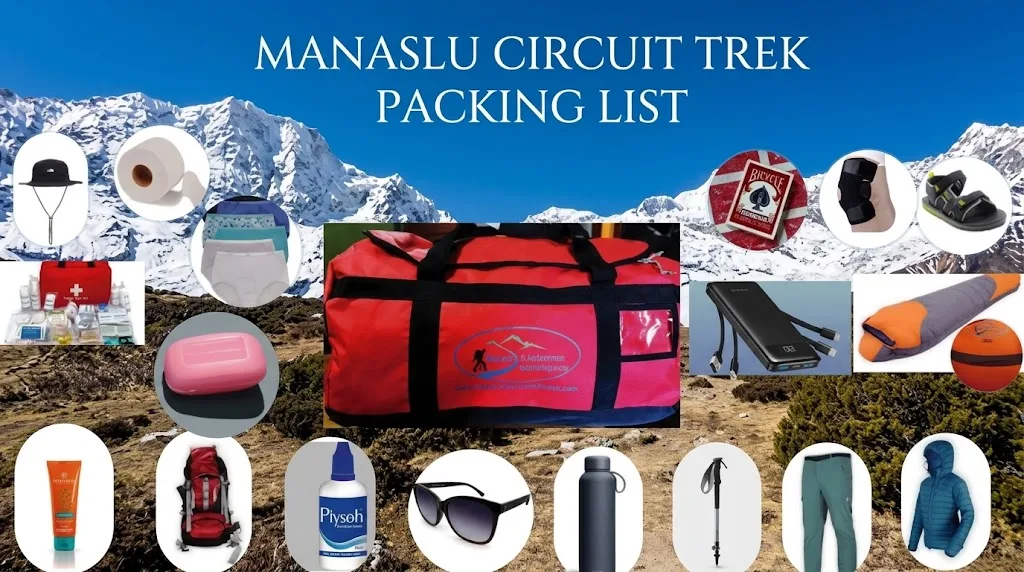
Manaslu Circuit Trek Packing Checklist
Use this quick checklist before leaving Kathmandu.
Clothing
- Thermal base layers
- Two or three trekking shirts
- Fleece jacket
- Down or insulated jacket
- Waterproof jacket
- Two trekking pants
- Warm trousers
- Underwear
- Four to five pairs of trekking socks
- Warm sleeping clothes
Footwear
- Broken-in hiking boots
- Camp shoes or sandals
- Gaiters
- Microspikes if required by conditions
Bags
- 25–35 liter daypack
- Trekking duffel or kit bag
- Rain cover
- Dry bags
Head and Hand Protection
- Warm hat
- Sun hat
- Lightweight gloves
- Warm insulated gloves
- Buff or neck gaiter
Trekking Equipment
- Trekking poles
- Headlamp
- Water bottles
- Water purification system
- Sleeping bag
- Sleeping bag liner
Sun Protection
- Sunglasses
- Sunscreen
- Lip balm with sun protection
Health and Hygiene
- Personal medication
- Basic first-aid supplies
- Blister treatment
- Toothbrush and toothpaste
- Wet wipes
- Toilet paper
- Hand sanitizer
- Small towel
- Moisturizer
Electronics
- Mobile phone
- Power bank
- Charging cables
- Camera if required
Documents
- Passport
- Travel insurance information
- Emergency contacts
- Trekking documents
- Copies of important documents
- Nepalese rupees
Packing for Different Seasons
Your final packing list should reflect the season in which you are trekking.
Spring
Spring can bring comfortable conditions at lower elevations, while higher sections may still be cold.
Warm clothing remains important because Larkya La and other high sections can experience winter-like conditions.
Autumn
Autumn is a popular trekking season, but temperatures can still be cold at night and around Larkya La.
Layering is important because daytime temperatures can feel comfortable while mornings and evenings remain cold.
Winter
Winter requires more preparation for freezing temperatures and possible snow.
A warmer sleeping bag, insulated clothing, good gloves, and suitable footwear become especially important. Snow conditions around Larkya La can also affect the route.
Monsoon
The lower Manaslu region can receive substantial rainfall during the monsoon season.
A reliable waterproof jacket, backpack rain cover, dry bags, and waterproof protection for your belongings are particularly useful.
Trail conditions can also become wet and muddy, making good footwear important.
How Much Should You Carry?
If you are using a porter, you only need to carry the items required during the day in your daypack.
Your main luggage can be transported separately between overnight stops.
Try to keep your personal luggage as light as possible. A lighter load makes steep climbs and long descents more comfortable.
Keep valuables, passports, money, medication, electronics, and other essential personal items in your daypack.
Before starting the trek, organize your equipment and remove anything you are unlikely to use.
Practical Packing Tips
Pack your most frequently used items where they are easy to reach.
Keep your waterproof jacket, water, snacks, gloves, sunscreen, sunglasses, phone, and personal medication in your daypack.
Organize your main luggage using lightweight packing cubes or dry bags. This keeps clothing separated and makes it easier to find what you need.
Keep one complete warm layer easily accessible because mountain temperatures can change quickly.
Protect electronics and important documents from rain and moisture.
Most importantly, check your hiking boots before leaving Kathmandu. Comfortable footwear can make a significant difference during long trekking days.
Final Thoughts
The Manaslu Circuit Trek requires thoughtful preparation because the route passes through several climate zones and reaches the high Larkya La Pass at 5,106 meters.
The best packing approach is to prepare for changing weather and altitude without carrying unnecessary weight. Focus on a good layering system, comfortable hiking boots, a warm insulated jacket, waterproof protection, a suitable sleeping bag, trekking poles, sun protection, and essential personal and medical supplies.
Your exact equipment requirements will depend on the season, weather, snow conditions, and your trekking itinerary. Conditions around Larkya La can change, so it is important to check the latest trail and weather information before crossing the pass.
Whether you are preparing for the Manaslu Circuit Trek, combining the route with the Tsum Valley Trek, or planning a Larke Pass Trek, the key is to prepare for changing weather, high altitude, and long walking days.
If you are trekking with a porter, use your daypack for essential items and let your main luggage be carried separately. This allows you to keep your daily load manageable while still having the clothing and equipment you need at each overnight stop.
With the right preparation and a carefully organized backpack, you can make the Manaslu Circuit more comfortable and concentrate on the Himalayan landscapes, mountain villages, Buddhist culture, dramatic valleys, and spectacular mountain views along the route.