
May 1, 2026
Everest Death Zone
 By admin
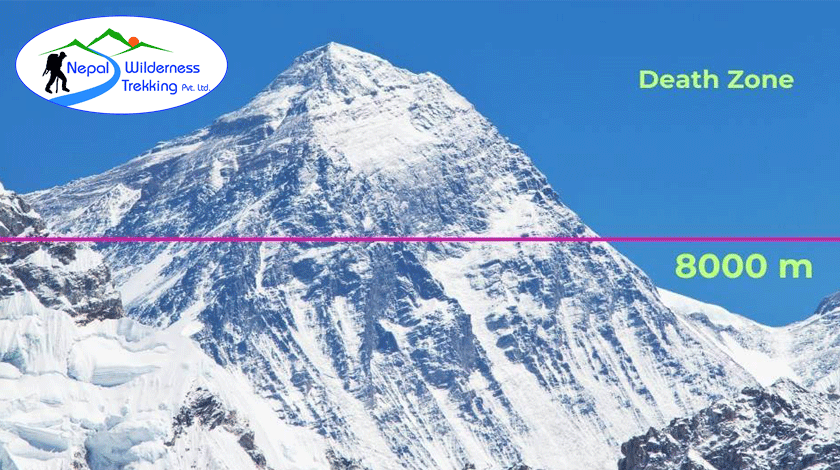
Everest Death Zone Above 8000 Meters
The Mountain Death Zone is one of the most hostile environments on Earth. It is the point at extreme altitude where the human body can no longer adapt to the lack of oxygen and begins to deteriorate instead of acclimatize. In mountaineering, this zone begins above 8,000 meters (26,247 feet), and nowhere is it more feared than on Mount Everest. The Mount Everest Death Zone is the final and most dangerous section of the world’s highest mountain, where climbers move slowly through thin air, freezing temperatures, and rapidly declining physical strength.
For decades, the Death Zone Everest has represented both the ultimate mountaineering challenge and the greatest danger in high-altitude climbing. Above this elevation, the body enters a state of gradual failure. Breathing becomes difficult, mental clarity declines, and even simple movement becomes exhausting. Every step requires intense effort, and every extra minute spent at this altitude increases the risk of death.
Understanding What Is the Death Zone on Everest is essential for anyone interested in Himalayan mountaineering. The Everest Summit Death Zone is not simply a high point on the mountain. It is a biologically hostile environment where survival depends on speed, oxygen, weather, judgment, and discipline. This is where climbers face the mountain’s final test, and where many of Everest’s greatest triumphs and tragedies unfold.
In this article, we explore the science, danger, and reality of the High Altitude Death Zone, including the Everest Death Zone Altitude, the Oxygen Level on Mount Everest, what happens to the human body Above 8000 Meters Everest, and how climbers attempt to survive Climbing Everest Death Zone.
What Is the Mountain Death Zone?
The Mountain Death Zone refers to altitudes above 8,000 meters, where atmospheric pressure becomes so low that the human body can no longer function properly for extended periods. At this elevation, oxygen is too limited to support long-term survival, even in healthy and well-acclimatized climbers.
The phrase was first introduced by Swiss physician Edouard Wyss-Dunant during the 1952 Swiss Everest expedition. He used the term to describe the point where the body begins to die because it cannot adapt further to the lack of oxygen.
Below 8,000 meters, the human body can gradually adjust to altitude through acclimatization. It produces more red blood cells, improves oxygen transport, and adapts to thinner air. But in the High Altitude Death Zone, that process stops working. Above this threshold, the body no longer adapts. Instead, it begins to weaken rapidly.
This is what makes the Mountain Death Zone so dangerous. It is not simply difficult. It is physiologically unsustainable.
What Is the Mount Everest Death Zone?
The Mount Everest Death Zone begins at approximately 8,000 meters and extends to the summit of Mount Everest at 8,848.86 meters. On the south side in Nepal, this zone begins just above the South Col near Camp IV. On the north side in Tibet, it begins above the final high camps on the northeast ridge.
This section of the mountain is the most dangerous part of the Everest climb. By the time climbers reach the Death Zone Everest, they are already physically depleted after weeks of climbing, acclimatization rotations, and exposure to cold, wind, and exhaustion. The summit may be close, but the danger is at its highest.
In the Everest Summit Death Zone, climbers operate at the edge of physical collapse. They leave Camp IV late at night, usually around midnight, and push upward through darkness toward the summit. Their goal is simple: climb as high as possible as quickly as possible, then descend before weather, fatigue, and oxygen loss become fatal.
Fast Facts About the Mount Everest Death Zone
Here are some essential facts about the Mount Everest Death Zone:
- The death zone begins at 8,000 meters (26,247 feet)
- Mount Everest’s summit stands at 8,848.86 meters
- Oxygen availability is roughly one-third of sea level
- Most climbers use supplemental oxygen above 8,000 meters
- Humans can survive here only for limited hours
- Most deaths happen during descent, not ascent
- Frostbite can develop within minutes in severe wind
- Rescue is extremely limited above 8,000 meters
- Many bodies remain on the mountain due to recovery risk
- Every minute in the death zone increases physical decline
These facts explain why the Death Zone Everest is one of the deadliest places in mountaineering.
Everest Death Zone Altitude Explained
The Everest Death Zone Altitude begins at around 8,000 meters because this is where oxygen pressure falls below the threshold needed for sustained human survival. Although the atmosphere still contains about 21% oxygen, the lower air pressure means far less oxygen enters the bloodstream with each breath.
This is the critical danger of being Above 8000 Meters Everest. Each breath contains too little usable oxygen. The lungs work harder, the heart beats faster, and the brain receives less oxygen with every passing hour.
At this altitude:
- movement becomes painfully slow
- recovery becomes nearly impossible
- decision-making becomes impaired
- dehydration accelerates
- body heat drops rapidly
- physical strength declines fast
The Everest Death Zone Altitude is often described as the upper limit of human survival because the body cannot remain here without deteriorating.
Scientific Cause Behind the Death Zone on Everest
The true danger of the Mount Everest Death Zone is rooted in human physiology. The greatest threat is not only cold or steep terrain. It is low atmospheric pressure.
At sea level, air pressure allows oxygen to move efficiently into the lungs and bloodstream. At 8,000 meters, atmospheric pressure is dramatically lower. This means the body receives much less oxygen even though the oxygen percentage in the air remains unchanged.
This causes hypoxia, a dangerous condition in which the brain and body do not receive enough oxygen to function properly.
In the High Altitude Death Zone, hypoxia causes:
- slowed brain function
- impaired judgment
- memory loss
- confusion
- reduced coordination
- loss of consciousness
This is why the Oxygen Level on Mount Everest becomes so dangerous. The body is not just tired. It is oxygen-starved.
Oxygen Level on Mount Everest
The Oxygen Level on Mount Everest is the single most important reason the death zone is deadly. While the air still contains roughly 21% oxygen, the pressure is so low near the summit that climbers effectively receive only about one-third of the oxygen available at sea level.
This reduced oxygen affects every organ system in the body.
The brain becomes slower and less reliable. Climbers may struggle to think clearly, make poor decisions, or lose awareness of danger. Muscles weaken rapidly. Balance and coordination decline. Even clipping into a rope or adjusting equipment can become difficult.
Without supplemental oxygen, the effects are far more severe. Even elite climbers moving without bottled oxygen face a much greater risk of confusion, collapse, and death in the Climbing Everest Death Zone environment.
Camp 4 South Col: The Final Stop Before the Summit
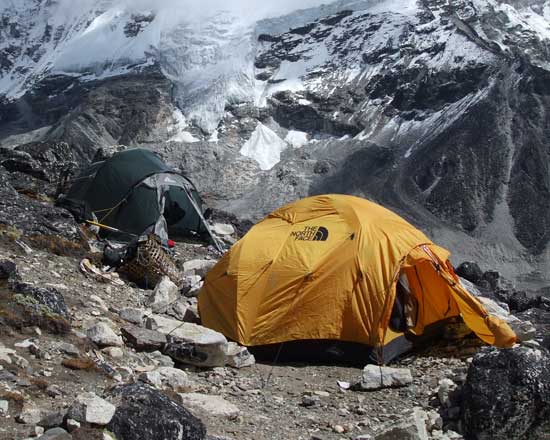
Camp IV, also known as the South Col, is the final high camp before the summit on the Nepal side of Everest. Located at around 7,900 to 8,000 meters, Camp IV sits at the edge of the Mount Everest Death Zone.
This is where climbers rest briefly before making their summit push. It is not a place for recovery. It is a temporary staging point where climbers hydrate, prepare oxygen systems, check weather, and leave for the summit window.
Camp IV is cold, exposed, and brutally uncomfortable. Wind batters the tents, temperatures plunge far below freezing, and sleep is almost impossible. Climbers spend only a few hours here before beginning the final ascent.
This is the last point before entering the full Everest Summit Death Zone.
What Happens to the Human Body Above 8000 Meters Everest?
The human body begins to fail rapidly Above 8000 Meters Everest. This is not ordinary fatigue. It is progressive biological breakdown.
In the High Altitude Death Zone, the body experiences:
- severe oxygen deprivation
- rapid dehydration
- muscle loss
- reduced digestion
- confusion
- poor coordination
- declining body temperature
- slower reaction time
The body burns energy faster than it can replace it. Appetite fades. Recovery stops. Mental clarity drops.
Even experienced climbers become vulnerable to poor decisions in the Death Zone Everest, not because they are careless, but because the brain itself is functioning with too little oxygen.
HAPE and HACE in the High Altitude Death Zone
Two of the deadliest medical threats in the High Altitude Death Zone are HAPE and HACE.
HAPE stands for High Altitude Pulmonary Edema. This occurs when fluid builds in the lungs, making breathing increasingly difficult. Symptoms include breathlessness, chest tightness, coughing, and weakness.
HACE stands for High Altitude Cerebral Edema. This occurs when the brain swells due to lack of oxygen. Symptoms include confusion, disorientation, loss of coordination, irrational behavior, and eventual unconsciousness.
Both conditions can be fatal. In the Mount Everest Death Zone, immediate descent is often the only effective treatment.
Why the Everest Summit Death Zone Is So Dangerous
The Everest Summit Death Zone is dangerous because it combines altitude, cold, exhaustion, and time pressure in one extreme environment.
Climbers in this zone face:
- severe cold
- low oxygen
- darkness
- technical terrain
- exhaustion
- limited rescue
- fast-changing weather
The summit is only part of the challenge. Climbers must also descend safely after reaching the top, often when they are most exhausted.
This is why the Everest Summit Death Zone is far more dangerous than the summit itself.
Why Most Deaths Happen During Descent
Most fatalities in the Death Zone Everest occur during descent rather than on the climb to the summit. While reaching the top is physically demanding, the return is often far more dangerous.
By the time climbers begin descending, they are usually severely exhausted, dehydrated, mentally slowed, and running low on supplemental oxygen. Their concentration drops, coordination weakens, and even simple decisions become harder to make. In the Mount Everest Death Zone, this level of fatigue can quickly turn small mistakes into fatal ones.
The descent also comes after the greatest physical effort of the expedition. Climbers are often moving down in worsening weather, fading daylight, and extreme cold, when both body and judgment are already near collapse.
Many climbers successfully reach the summit of Everest, but the real danger begins on the way down. On Everest, reaching the top is only half the journey—surviving the descent is what truly determines success.
The 2 PM Rule on Everest
One of the most important safety rules in the Mount Everest Death Zone is the 2 PM rule.
If a climber has not reached the summit by 2:00 PM, they should turn around, regardless of how close they are.
This rule exists because summit delays are deadly. Climbers who summit too late risk descending in darkness, in colder temperatures, and with dangerously low oxygen.
On Everest, turning back is often the decision that saves lives.
Khumbu Icefall vs Death Zone Everest
The Khumbu Icefall and the Death Zone Everest are the two most dangerous parts of the south-side Everest route, but they are dangerous for different reasons.
The Khumbu Icefall is unstable and objective-danger heavy. It is threatened by collapsing ice, avalanches, crevasses, and falling seracs.
The Mount Everest Death Zone is less unstable but more lethal physiologically. Its greatest danger is oxygen deprivation, exhaustion, and human failure under extreme altitude.
The Icefall is more unstable. The death zone is more biologically deadly.
Why Rescue Is Nearly Impossible Above 8000 Meters Everest
Rescue Above 8000 Meters Everest is extremely limited.
Helicopters cannot reliably perform rescue missions at this altitude. Ground rescue is painfully slow, dangerous, and physically exhausting. Even highly trained rescuers struggle to function in the death zone.
This is why self-reliance is critical in the Climbing Everest Death Zone environment. Above 8,000 meters, climbers must often depend on themselves, teammates, and Sherpa support.
Why Bodies Remain in the Death Zone Everest
One of the harshest realities of the Death Zone Everest is that many bodies remain on the mountain.
Recovering a body above 8,000 meters is dangerous, technically difficult, and extremely expensive. It can take multiple climbers, fixed systems, and enormous physical effort in one of the harshest environments on Earth.
In many cases, recovering the dead puts the living at greater risk.
This is why many climbers remain where they died in the Mount Everest Death Zone.
How Climbers Survive Climbing Everest Death Zone
Surviving Climbing Everest Death Zone depends on preparation, discipline, and speed.
The key survival strategies include:
- proper acclimatization
- strong weather planning
- supplemental oxygen
- efficient pacing
- hydration
- strict turnaround times
- experienced Sherpa support
- fast descent after summit
No one survives the Mount Everest Death Zone through strength alone. Survival depends on preparation and judgment.
When climbers attempt Everest, the journey through the Death Zone Everest is not only physically demanding but also emotionally significant for their families and supporters. Many friends and family members travel to Nepal to follow the expedition closely. Some join the Everest Base Camp trek (EBC trek) to reach Base Camp, while others wait in Kathmandu for updates from the mountain.
At Base Camp, supporters often witness the preparation phase and later take part in small celebration ceremonies when climbers return safely after a successful summit of the Mount Everest Death Zone. This moment becomes especially meaningful after surviving the extreme risks above 8,000 meters, including the Everest Summit Death Zone. Such gatherings add emotional strength and motivation throughout the expedition journey.
Final Thoughts
The Mountain Death Zone remains one of the harshest and most unforgiving environments on Earth, and the Mount Everest Death Zone is its most well-known and feared example. Above 8,000 meters, the human body begins to fail. Oxygen becomes dangerously scarce, recovery is no longer possible, and even simple decisions can become life-threatening. In this extreme environment, strength alone is never enough. Survival depends on preparation, discipline, timing, and the ability to turn back when conditions demand it.
Understanding What Is the Death Zone on Everest helps explain why Everest continues to command both admiration and respect. The brutal Everest Death Zone Altitude, the dangerously low Oxygen Level on Mount Everest, and the physical breakdown that begins Above 8000 Meters Everest make this final section of the mountain one of the most dangerous places a human can willingly enter. It is where ambition meets its absolute limit, and where the mountain tests every weakness.
The Everest Summit Death Zone has also become a place of unforgettable stories. One of the most haunting is that of Francys Arsentiev, remembered by many climbers as the “Sleeping Beauty of Everest.” In 1998, she became the first American woman to summit Everest without supplemental oxygen, but she never returned. Exhausted, hypoxic, and unable to descend, she died high on the mountain during the return from the summit. Her still form, seen by climbers for years afterward, became one of the most haunting symbols of Everest’s beauty, danger, and indifference. Her story remains one of the clearest reminders that reaching the summit is never the end of the climb.
For climbers, the Death Zone Everest is not simply the final approach to the summit. It is the mountain’s last and greatest test. This is where endurance, judgment, humility, and experience matter more than ambition. Everest does not become dangerous only because it is high. It becomes dangerous because, in the death zone, every step must be earned, and every mistake is magnified. In the end, the Mount Everest Death Zone is not just the final stretch to the top. It is the mountain’s final decision.
Trekking is essentially day hiking and doesn't require any special training. However, good physical condition, a love of walking, and a desire to enjoy mountain views and village life are essential.
These treks are suitable for walkers looking for something more challenging and energetic. Hill-walking experience is desirable, with longer days and higher elevations.
Since the terrain can be hard and the days long, hikers should be in good physical condition and have previous mountain walking experience. High passes and extended trekking days may be involved.
This is challenging and technical trekking or climbing in Nepal. Participants should be physically fit, mentally prepared, and ready for off-the-beaten-trail routes, camping, or high passes.
This is a very demanding expedition level trip for experienced trekkers or climbers. Strong fitness, preparation, and confidence in remote high-altitude conditions are required.
Trekking is essentially day hiking and doesn't require any special training. However, good physical condition, a love of walking, and a desire to enjoy mountain views and village life are essential.
These treks are suitable for walkers looking for something more challenging and energetic. Hill-walking experience is desirable, with longer days and higher elevations.
Since the terrain can be hard and the days long, hikers should be in good physical condition and have previous mountain walking experience. High passes and extended trekking days may be involved.
This is challenging and technical trekking or climbing in Nepal. Participants should be physically fit, mentally prepared, and ready for off-the-beaten-trail routes, camping, or high passes.