
September 23, 2026
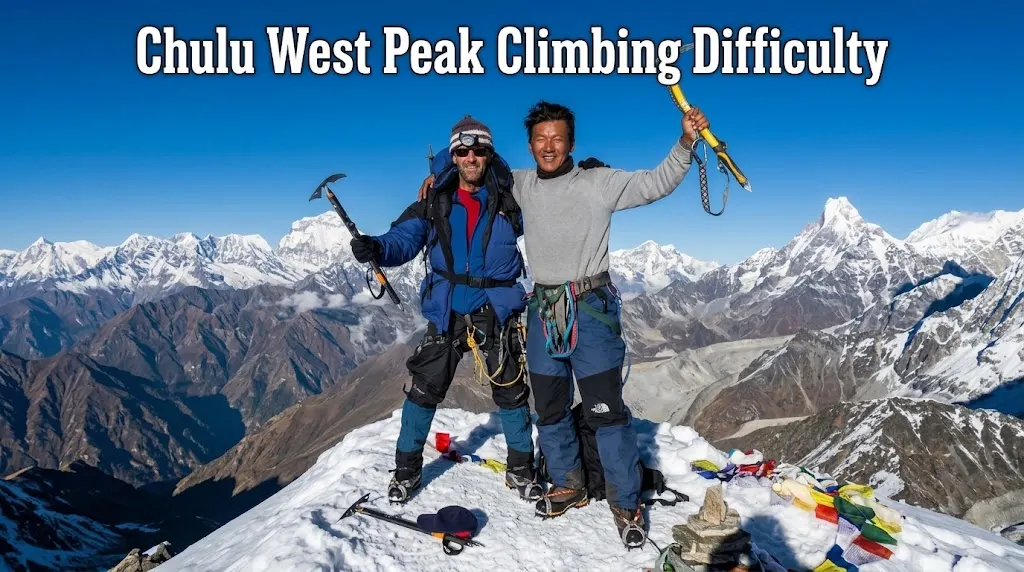
Chulu West Peak Climbing Difficulty
 By admin
Chulu West Peak Climbing Difficulty: A Complete Guide for First-Time Climbers
Chulu West Peak is a serious Himalayan climbing objective at 6,419 meters (21,060 feet). For trekkers who have completed high-altitude routes and want to move into mountaineering, it can be an exciting next step. However, the climb requires more preparation than a normal trekking journey.
One of the most common questions from prospective climbers is: How difficult is Chulu West Peak climbing? The answer depends on your previous experience, physical condition, acclimatization, technical ability, weather, snow conditions, and how well you prepare before arriving in Nepal.
Chulu West is not necessarily difficult because of one extremely technical climbing section. The bigger challenge comes from combining high altitude, steep terrain, cold temperatures, long climbing hours, snow and ice, and the physical demands of a summit day.
This guide explains what makes Chulu West difficult and how you can prepare for the climb.
How Difficult Is Chulu West Peak?
Chulu West is best considered a challenging high-altitude Himalayan peak. The difficulty is different from that of a normal trekking route. During a trek, most of the challenge comes from walking for several hours at altitude. During a peak climb, you also need to deal with climbing equipment and changing terrain.
Several factors determine the difficulty:
- Elevation above 6,000 meters
- Lower oxygen levels
- Long days at high altitude
- Steep slopes
- Snow and ice
- Cold temperatures
- Variable weather
- Technical climbing skills
- Summit-day fatigue
- The need to descend safely after reaching the summit
For an experienced trekker with good fitness and basic mountaineering skills, the climb can be manageable with proper preparation.
For someone with no high-altitude trekking or climbing experience, it requires considerably more preparation.
The Biggest Challenge: Altitude
The altitude is one of the most important factors when considering Chulu West Peak.
At 6,419 meters, the summit is significantly higher than most popular trekking destinations in Nepal.
As you ascend, atmospheric pressure decreases and there is less oxygen available with each breath. Your body needs time to adjust.
This is why someone who is very fit at sea level can still struggle in the Himalayas.
Altitude-related problems can affect anyone, regardless of age or physical fitness.
Common symptoms of altitude sickness can include:
- Headache
- Tiredness
- Dizziness
- Loss of appetite
- Nausea
- Difficulty sleeping
- Shortness of breath
More serious symptoms require immediate attention and descent.
The most important principle is simple: do not continue ascending when your body is showing serious signs of altitude illness.
Why Acclimatization Matters So Much
Good acclimatization can make a major difference during a Chulu West expedition.
The body needs time to adapt to the changing altitude. A well-designed expedition therefore does not rush directly toward the summit.
The approach through the Annapurna region provides a gradual increase in elevation, giving climbers time to adapt before reaching the climbing section.
However, acclimatization is not simply about spending one night at a particular altitude.
Your guide should monitor:
- Sleeping altitude
- Daily elevation gain
- Physical condition
- Appetite
- Hydration
- Sleep quality
- Symptoms of altitude sickness
A climber who feels strong at a lower elevation should still respect the mountain at higher altitude.
Does Being Fit Make Chulu West Easy?
Fitness helps, but fitness alone does not make a 6,419-meter climb easy.
A strong cardiovascular system allows you to walk more efficiently. Strong legs help on steep terrain, while good endurance helps during long summit days.
But altitude affects everyone differently.
You can be an excellent runner and still have difficulty acclimatizing.
This is why preparation should combine fitness, altitude experience, technical skills, and mental readiness.
What Type of Fitness Do You Need?
You do not need to become a professional athlete before climbing Chulu West.
You should instead build practical mountain fitness.
Cardiovascular Endurance
Activities such as:
- Hiking
- Running
- Cycling
- Swimming
- Stair climbing
can improve cardiovascular endurance.
Try to exercise consistently rather than doing very difficult workouts only occasionally.
Leg Strength
Your legs will work hard during both the ascent and descent.
Useful exercises include:
- Squats
- Lunges
- Step-ups
- Hill walking
- Stair climbing
- Calf exercises
Core Strength
A strong core helps you remain stable while carrying a backpack and moving over uneven terrain.
Planks and other functional core exercises can be useful.
Endurance With a Backpack
Training without carrying anything is not exactly the same as trekking in the Himalayas.
Include some longer hikes with a backpack before your expedition.
This helps your body become accustomed to walking for several hours while carrying equipment.
How Long Should You Train Before Chulu West?
There is no single training period that works for everyone.
A person who regularly hikes and exercises may need less preparation than someone starting from a sedentary lifestyle.
As a general approach, begin structured training at least 8–12 weeks before the expedition, with longer preparation being beneficial if you are new to mountain trekking.
Start gradually.
Increase:
- Distance
- Elevation gain
- Walking duration
- Backpack weight
- Consecutive hiking days
The objective is to arrive in Nepal strong and healthy, not exhausted from excessive training.
Do You Need Previous Mountaineering Experience?
Previous climbing experience is highly useful for Chulu West.
You should ideally understand basic mountaineering techniques before attempting the summit.
Useful skills include:
- Walking with crampons
- Using an ice axe
- Moving on snow
- Using a climbing harness
- Understanding rope systems
- Basic self-arrest techniques
- Moving safely on steep terrain
- Using climbing hardware
If you have never used this equipment, training before the expedition can significantly improve your confidence.
A professional climbing guide can also provide practical instruction during the expedition.
Crampons and Ice Axe Skills
Walking with crampons is different from normal hiking.
Your foot placement needs to be deliberate because a poor step can cause a loss of balance.
You should learn how to:
- Walk efficiently with crampons
- Move uphill
- Move downhill
- Cross uneven snow
- Maintain balance on steeper sections
An ice axe is another essential tool in appropriate conditions.
It can be used for balance and, depending on the terrain and technique, arresting a slide.
Learning these skills before summit day is much better than trying to understand them for the first time when you are tired and cold.
How Technical Is Chulu West?
The technical difficulty of Chulu West can vary according to route and mountain conditions.
Snow and ice conditions are not identical every year.
A route that is relatively straightforward under good conditions can become more demanding after heavy snowfall, strong winds, or changes in the snowpack.
This is why a fixed description of the mountain’s technical difficulty does not tell the entire story.
Your climbing team should assess the route based on:
- Current snow conditions
- Ice conditions
- Visibility
- Wind
- Temperature
- Route accessibility
- Recent snowfall
- Avalanche concerns
- Condition of climbing equipment
Mountain conditions always take priority over a previous season’s description.
What Makes Summit Day Difficult?
Summit day is usually the hardest physical part of the expedition.
You may start during the night or very early in the morning to take advantage of suitable conditions.
At this stage, you are already tired from several days of trekking and climbing preparation.
You may also be dealing with:
- Cold temperatures
- Darkness
- High altitude
- Steep terrain
- Snow
- Wind
- Heavy clothing
- Climbing equipment
- Limited oxygen
Every step can feel slower at high altitude.
The key is to maintain a steady pace instead of trying to move quickly.
Why Descending Can Be Harder Than Expected
Reaching the summit is only half of the final challenge.
After several hours of climbing, you may be physically exhausted.
The descent requires concentration because tired climbers can make mistakes.
Steep snow, loose terrain, changing weather, and reduced energy can make descending demanding.
A good climbing plan therefore leaves enough time and energy for a controlled descent.
Summit success should never be the only objective. Returning safely is equally important.
How Cold Is Chulu West?
Temperature becomes increasingly challenging as you gain elevation.
The combination of low temperature, wind, snow, and exposure can make conditions feel much colder than the actual air temperature.
You need an appropriate layering system.
A practical system may include:
Base Layer
Moves moisture away from your skin.
Insulating Layer
Provides warmth while remaining breathable.
Down Jacket
Provides additional insulation at higher elevations and during rest periods.
Outer Shell
Protects against wind, snow, and moisture.
You also need warm gloves, a hat, suitable socks, and face protection.
Cold management is not just about comfort. Cold fingers and toes can become a serious problem during a climb.
How Important Are Good Boots?
Your footwear is one of the most important pieces of personal climbing equipment.
For the climbing section, appropriate mountaineering boots should:
- Fit correctly
- Provide sufficient insulation
- Work with the selected crampons
- Protect your feet from cold and moisture
- Be comfortable enough for long hours
Never take brand-new boots directly onto a major summit attempt.
Break them in beforehand and test them with your climbing socks.
Foot problems that seem minor at home can become much more serious after several hours in freezing conditions.
Mental Preparation for Chulu West
Physical preparation gets most of the attention, but mental preparation also matters.
At high altitude, progress can feel extremely slow.
You may spend several hours climbing while the summit still appears far away.
There can also be moments when the weather changes or you feel tired and wonder whether you can continue.
Useful mental strategies include:
- Maintaining a steady pace
- Focusing on the next section rather than the entire mountain
- Staying calm when conditions change
- Listening to your guide
- Accepting that the itinerary may change
- Being prepared to turn around if conditions become unsafe
- Mountaineering requires patience.
What If You Have Never Climbed Above 6,000 Meters?
Not having climbed above 6,000 meters does not automatically mean you cannot consider Chulu West.
However, you should honestly evaluate your previous experience.
Ask yourself:
- Have I completed multi-day high-altitude treks?
- Can I walk for 6–8 hours on consecutive days?
- Have I trained with a backpack?
- Have I used crampons?
- Have I used an ice axe?
- Am I comfortable with steep terrain?
- Do I understand basic altitude safety?
- Can I handle cold conditions?
If most answers are yes, you may have a useful foundation.
If you have never trekked at high altitude and have no mountaineering experience, Chulu West requires much more preparation.
Common Mistakes Climbers Make
Several mistakes can make a high-altitude climb unnecessarily difficult.
Walking Too Fast
Trying to keep up with stronger members can cause unnecessary exhaustion.
Ignoring Hydration
Cold weather often reduces the sensation of thirst, but hydration remains important.
Underestimating the Cold
Lower-elevation trekking clothing may not be enough for the summit.
Carrying Too Much
An overloaded backpack wastes energy.
Poor Sleep Before Summit Day
Rest is important before a long climbing day.
Ignoring Early Symptoms
Small altitude-related symptoms should not automatically be dismissed.
Focusing Only on the Summit
A successful expedition includes safe ascent, summit attempt, and descent.
Relying on Old Route Information
Mountain conditions change.
Your climbing team should make decisions based on current conditions rather than relying entirely on an old itinerary or previous climbers’ reports.
Can a Guide Make the Climb Easier?
A professional climbing guide cannot remove the physical challenge of Chulu West, but good guidance can help you manage the expedition more effectively.
An experienced guide can assist with:
- Route finding
- Acclimatization decisions
- Pace management
- Climbing techniques
- Equipment checks
- Weather assessment
- Camp organization
- Rope systems where required
- Emergency response
- Summit-day planning
A guide can also recognize when a climber is struggling and recommend slowing down, resting, or descending when necessary.
What Should You Do Before Arriving in Nepal?
Preparation should begin before your flight.
Three Months Before
Start building endurance and strength.
Two Months Before
Add longer hikes and elevation gain.
One Month Before
Practice hiking with your planned footwear and backpack.
If possible, receive basic mountaineering instruction.
Two Weeks Before
Avoid exhausting workouts and focus on maintaining fitness and getting adequate rest.
Before Flying
Check:
- Travel insurance
- High-altitude coverage
- Mountaineering coverage
- Personal climbing equipment
- Passport
- Required documents
- Medication and first-aid items
- Appropriate clothing
Good preparation reduces avoidable problems during the expedition.
Chulu West for Experienced Trekkers
Chulu West can be an attractive option for trekkers who want to progress from trekking into Himalayan climbing.
Someone who has already completed routes such as the Annapurna Circuit Trek, Everest Base Camp, Manaslu Circuit, or other high-altitude treks may already understand some of the physical demands of the Himalayas.
However, trekking experience and mountaineering experience are not identical.
A strong trekker should still learn the technical skills required for the climbing section.
How Do You Know If Chulu West Is Right for You?
There is no universal checklist that can guarantee summit success.
Instead, consider the complete picture:
Experience + fitness + acclimatization + technical skills + equipment + weather + professional support
If one area is weak, improve it before the expedition.
Do not choose a peak only because of its elevation.
Choose a mountain that matches your experience, preparation, available time, and climbing goals.
Final Preparation Checklist
Before starting your Chulu West Peak expedition, make sure you have considered:
Physical Preparation
- Regular cardiovascular training
- Strong legs
- Good endurance
- Long-distance hiking practice
- Backpack training
Technical Preparation
- Crampon use
- Ice axe handling
- Snow walking
- Harness use
- Basic rope techniques
- Self-arrest awareness
Personal Equipment
- Suitable mountaineering boots
- Warm gloves
- Down jacket
- Waterproof layers
- Sleeping bag
- Headlamp
- Sunglasses/goggles
- Trekking poles
- Backpack
Safety Preparation
- Travel insurance
- High-altitude coverage
- Emergency evacuation coverage
- Understanding altitude sickness
- Emergency contact information
Mental Preparation
- Patience
- Flexibility
- Willingness to follow safety advice
- Acceptance that weather can change plans
- Understanding that turning around can be the correct decision
Chulu West Peak: Is It Worth Preparing For?
Chulu West Peak offers a natural progression for people who want more than a conventional Himalayan trek.
The mountain combines high-altitude trekking with genuine mountaineering skills. The challenge comes not from one factor alone but from the combination of elevation, cold, steep terrain, snow, endurance, and changing mountain conditions.
With proper preparation, gradual acclimatization, appropriate equipment, and experienced climbing support, the expedition can become a memorable Himalayan achievement.
The most important preparation is to respect the mountain.
Train well, understand your own limits, listen to experienced guides, and allow the mountain conditions to determine the pace and summit plan.
For the complete itinerary, climbing logistics, permits, services, and current package information, visit our Chulu West Peak Climbing page.
Related Trekking and Climbing Guides
- Manaslu Annapurna Circuit Trek – a classic high-altitude trekking route that can be combined with Chulu West.
- Pisang Peak Climbing – another climbing option in the Annapurna region.
- Chulu Far East Peak Climbing – an alternative Chulu-group climbing objective.
- Thorong La Pass Trek – information about one of the major high passes in the Annapurna region.